
| 8 mins read
SUMMARY
- Proportional Representation (PR) may not protect the interests of ethnic minorities, as some have claimed.
- PR could allow parties organised around an ethnic or religious constituency to win seats but this may harden societal cleavage; stop mainstream parties appealing to minorities; and leave them represented but rarely governing.
- Under PR's low thresholds and post-election bargaining, support for extreme factions more easily converts into seats and leverage. But first-past-the-post is not risk-free either.
- A single-member ranked-choice system could serve ethnic minorities (and the polity as a whole) better.
The main case being made for replacing UK’s first-past-the-post system (FPTP) is fairness: the mismatch between votes and seats, never starker than in 2024. But the debate also contains two apparently opposed claims about ethnic minorities. Supporters of proportional representation (PR) say it would produce a Commons that looks more like the country. Opponents point to Reform UK and ask why Britain should adopt a system that would give an extremist party many more seats and greater influence over government.
The two claims rely on different conceptions of representation. The optimistic claim rests mainly on descriptive representation: whether Parliament includes minority members. The worry concerns substantive representation: whether the system produces policies and governments that protect the interests of ethnic minorities. Once that distinction is understood, the case for a proportionately elected Commons looks weaker.
Descriptive representation
The familiar argument for PR draws heavily on the representation of women. Under closed-list PR, a party expecting several seats can place women high on its list without displacing any particular man. That advantage is weaker in candidate-centred proportional systems such as Ireland’s, where women’s representation remained low until candidate quotas were introduced. On the other hand, Britain elected a record 263 women in 2024 under FPTP plurality, while Australia’s ranked-choice voting (RCV) majoritarian system returned 46% women in 2025.
The evidence about women cannot simply be transferred to ethnic minorities. Women form roughly half the electorate and are spread fairly evenly across constituencies. Britain’s ethnic minorities are unevenly concentrated, which explains how minority MPs made up almost 14% of the Commons after the 2024 election. The aggregate gap has largely closed, although Caribbean, Chinese, and mixed-heritage Britons remain under-represented.
PR also creates another route to minority representation with little parallel for women. A low threshold allows parties organised around an ethnic or religious constituency to win seats on that constituency’s votes alone. This may secure a voice for an excluded group. But it can also harden societal cleavage and relieve mainstream parties of pressure to include minority candidates and interests, leaving ethnic minorities represented but rarely governing. Britain has no substantial ethnic party at present. A PR-based Commons could change that over time.
Substantive representation
Even where PR increases the number of minority legislators, it does not follow that policy will better serve minorities. Minority politicians now sit across the ideological spectrum. Parveen Akhtar has argued, on recent data, that minority voters tend to care more about the substantive representation of their interests than about the descriptive representation of their identity. Rishi Sunak’s premiership, after all, did not cause British Asians to break en masse for Conservatives, while Labour’s stance on Gaza moved many Muslim votes to the Greens, now led by a Jewish gay man.
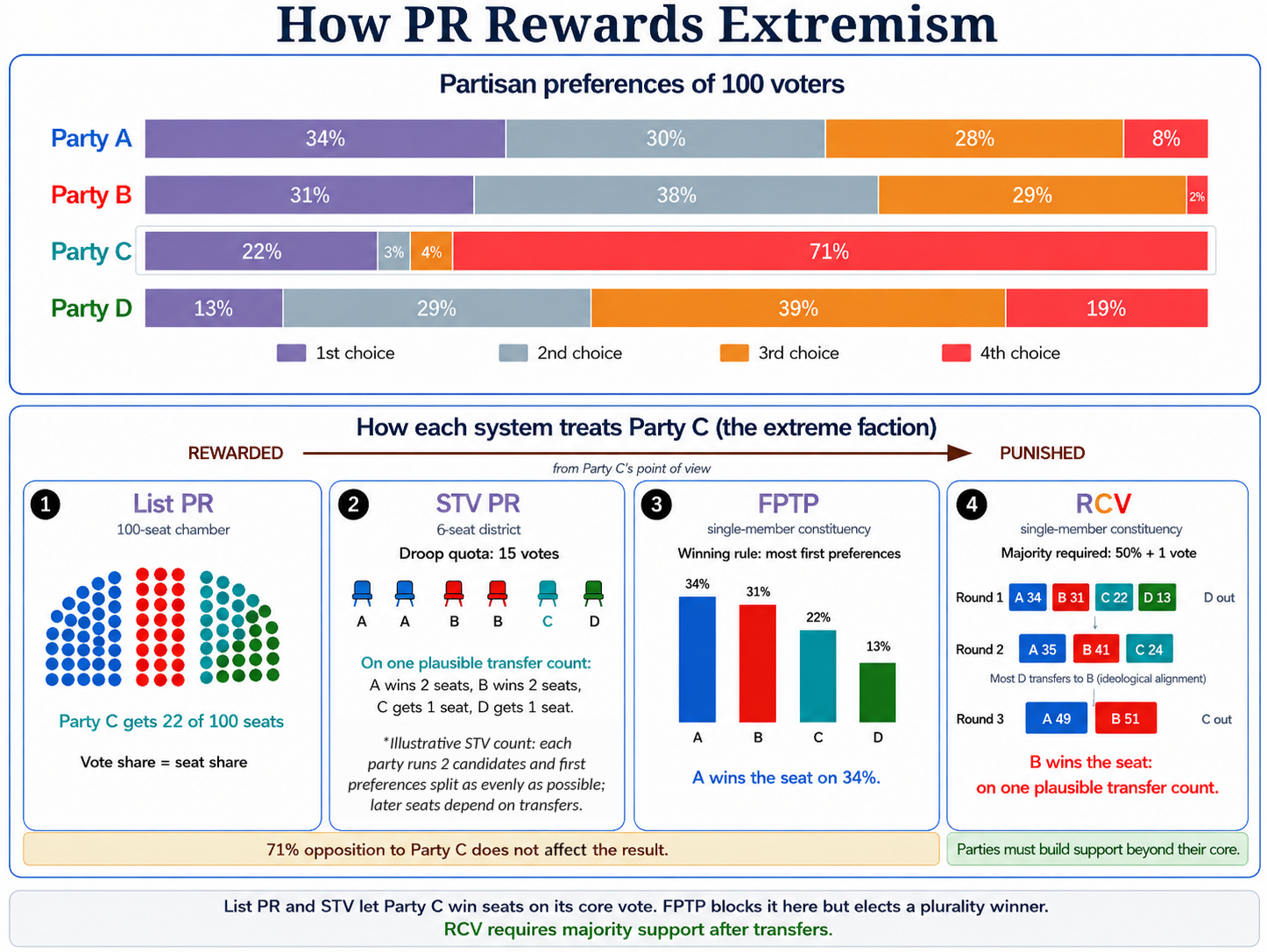
A party, however partisan, frames a platform that is theoretically justifiable to all of the people. A faction excludes a section of them—often one or more ethnic minorities—from its concern at the outset. As the graphic shows, under list PR Party C converts 22% of first preferences into 22% of seats, even though 71% of voters ranked it last. In a fragmented chamber, that bloc may influence who governs and on what terms. FPTP turned Reform UK’s more than four million votes into only five seats in 2024; PR would have given it about 94. At the 2026 Senedd election, the first under Wales’s new closed-list PR system, Reform became the second-largest bloc in a chamber with no majority.
Admittedly, factions can arise under any system. What differs is how readily their support converts into seats and leverage, which PR’s low thresholds and post-election bargaining make easier. The single transferable vote does not remove the problem: with six seats and 100 voters, the Droop quota is 15 votes, so C wins a seat without needing transfers from any other party. The 71 voters who rank it last play no part in that result. While PR’s role in the rise of the Nazis remains contested, far-Right factions today are successfully entering government under European PR systems.
First-past-the-post is not risk-free either. It suppresses a dispersed faction for a time, but can hand it full executive power once it reaches roughly 30% and its opponents divide. In India in 2014, a minority-excluding faction won a parliamentary majority with 31.3% of the vote. FPTP sets a higher threshold than PR, but it offers no reliable safeguard.
The case for ranked-choice voting
A single-member ranked-choice system requires a majority of continuing ballots after transfers and is likely to serve ethnic minorities (and the polity as a whole) better. Furthermore, it retains the constituency link. Where no candidate has a majority of first preferences, lower preferences decide the contest. Candidates have to convince voters of other parties to at least tolerate them, while a faction loved by some but loathed by many is unlikely to attract the necessary transfers. This is the alternative vote system rejected in the 2011 referendum, but the case for it deserves another hearing in a much more fragmented party system of 2026. No electoral system can protect a minority if an overwhelming hostile majority is determined to exclude it. In Britain, where this is mercifully not the case, electoral design can matter a great deal to whether minorities are integrated, segregated, ignored, or persecuted.
The larger mistake is to ask one chamber and one electoral system to perform two different jobs. The Commons chooses the government. Therefore, it should be elected by single-member RCV, a system that is most likely to secure the least-hated government. A reformed revising chamber, however, could be constituted indirectly and proportionately on the basis of first preferences cast for the Commons. This would give all significant strands of opinion a voice without allowing a small faction to hold the balance of power over the executive. RCV accounts for the intensity of voter preferences, whereas list PR converts first preferences, whether mild or intense, into seats. Neither is self-evidently fairer, but one is decidedly worse for minorities.
Digested Read created by the author.
Need help using Wiley? Click here for help using Wiley


