
| 10 mins read
SUMMARY
- The UK electoral franchises prohibit voting on the basis of some, but not all, nationalities.
- Unenfranchised adults outnumber the number of votes cast for the sitting MP in 36 seats. If all residents could vote, 257 seats could have had a different outcome at the 2024 general election.
- Residence-based voting involves allowing all adults who are legally resident in a country to vote. It has been introduced in Scotland and Wales for some elections.
- There has been an increase in the number of unenfranchised adults from 2.3 million in 2011 to 4.4 million in 2025.
- Universal suffrage is a defining feature of democracy. There is no clear democratic, legal or logical rationale to defend the current electoral franchise. It deserves a rethink.
The injustice of the pre-reform disenfranchisement is striking to the modern eye – Manchester, for example, had a population of a quarter of a million but no representation in the House of Commons prior to 1832. However, legal barriers to voting remain in the UK for people who are adults, long-term residents and who contribute to society economically and culturally.
How many unenfranchised adults are there at both parliamentary and local elections across the UK?
The case for residence-based voting
The population of the UK was estimated to be 68.3 million by the middle of 2023. The 2021/22 census shows that 16 per cent of people in the UK were born abroad—around 10.7 million migrants. As of December 2024, 5.75 million (19 per cent) of the UK workforce were non-UK nationals.
All residents contribute in some way towards society, and are affected by the decisions made inside parliamentary and local institutions and are required to abide by the laws of the state or face punishment. However, not all are considered to be full members of society in terms of the rights the state bestows upon them.
There are three sets of arguments for extending the franchise to all residents.
The first is that it would bring the UK into line with international best practices on elections. Article 21 of the Universal Declaration of Human Rights states that ‘everyone has the right to take part in the government of his [sic] country, directly or through freely chosen representatives’, and that elections ‘shall be by universal and equal suffrage’.
The Venice Commission Code specifies that most countries do limit voting by nationality, but that ‘a tendency is emerging to grant local political rights to long-standing foreign residents, in accordance with the Council of Europe Convention on the Participation of Foreigners in Public Life at Local Level’. The UK is signed up to this Convention.
The second set of arguments comes from democratic theory. The basic claim is that residence-based voting would give a voice to people who contribute to society and are affected by the decisions made to create an inclusive democracy.
Theories of empowerment argue that elections are one critical way in which people are empowered. However, elections can also be disempowering practices for people are not legally allowed to participate.
Overlapping with this, stakeholder theories argue meanwhile that unenfranchised residents have a genuine stake in the society in which they live. Theories of interest argue that anyone who is affected by a decision should have the entitlement to be involved in that decision.
A further argument from theories of deliberation is that democracy involves listening. Enfranchisement would enable greater listening.
A third set of arguments is that residence-based voting would bring consistency and simplicity to electoral law. Residence-based voting has long existed in the UK for citizens from Commonwealth countries. It has been introduced in Scotland and Wales for local and national elections to the Senedd and Scottish Parliament to enfranchise non-Commonwealth citizens.
The electoral franchises in the UK
In the long durée of history, the franchise has expanded across the UK. Table 1 summarises the current status quo on voting rights. Voting is restricted to British, Irish or qualifying Commonwealth citizens for UK parliamentary elections.

Table 1. Who can vote in the UK? Source: authors, updating Fox, et al.
EU citizens could, until recently, vote in local elections. Following Brexit, however, the Conservative-led UK government agreed bilateral treaties with some countries to allow mutual voting rights to continue.
Because the franchise for local elections was devolved, there is now a complex patchwork of franchises in the UK. These contradictions are further exposed if we compare those used for referendums. In the 2014 Scottish independence referendum, all residents were allowed to vote, including EU nationals, and 16 and 17-year-olds. However, the June 2016 EU referendum was limited to British, Irish and qualifying Commonwealth citizens aged 18 or over, explicitly excluding EU residents.
Estimated unenfranchised citizens
How many UK residents do not have the right to vote?
It has previously been estimated that in England and Wales alone, 2.3 million immigrants were excluded from voting at the 2015 general election.
New estimates are provided in this article using a two-step methodology. Migration statistics often use the terminology of ‘stocks’ and ‘flows’. Stocks refers to the number of migrants who are usually resident in a country at a given moment in time. Flows refers to the number of people who have changed their residency during a particular period.
Unenfranchised adults in 2021
The main category of stock people who are not enfranchised in the 2021 census is those from non-Commonwealth and non-EU countries. Using the estimate methods detailed in our full-length article, this would be 754,037 in England plus 12,329 unenfranchised people in Northern Ireland.
Unenfranchised adults in 2025
For a variety of reasons, there has been a major change in migration patterns since 2021. Data from the ONS estimated that the number of people entering the UK was 1,257,000 in 2022 and 1,218,000 in 2023. EU arrivals made up 15 per cent (188,500) of these, with the majority being non-EU.
Many of these migrants would have automatically gained full electoral rights upon moving to the UK based on having a qualifying Commonwealth or other nationality, but many others will not. We estimated the trajectory of these over a seven-year period in Table 2 below.
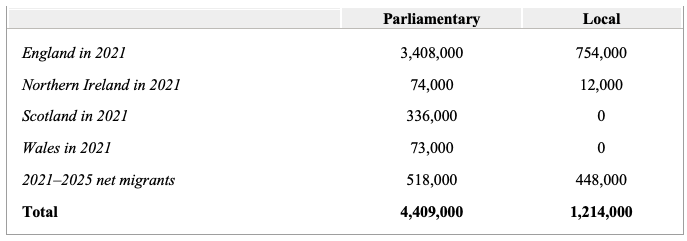
Table 2. Overall estimates of unenfranchised residents
The political consequences of enfranchising residents
There is a mean of 6,676 unenfranchised residents per English Westminster constituency. There is considerable variation by constituency. The constituency with the highest number is Kensington and Bayswater at 32,980. The registered electorate in the 2024 general election for this constituency was 77,306. This means that 30 per cent of adults were barred from participating in the election. Figure 1 maps the variations across the UK.
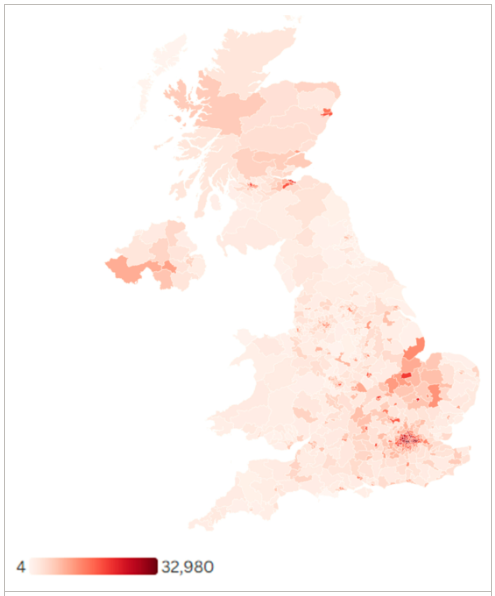
Figure 1: Unenfranchised adults in UK Parliamentary constituencies
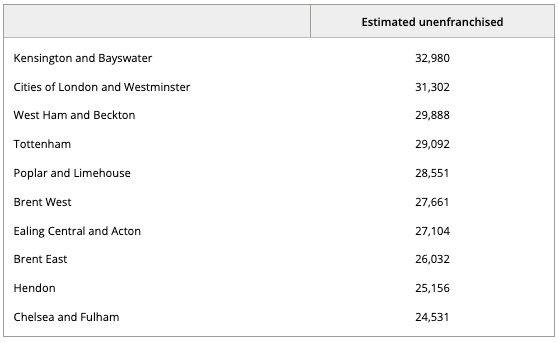
Table 3. Parliamentary constituencies with the largest volume of ineligible people in England and Wales based on the stock of people in the 2021 census Constituency
The ineligibility of unenfranchised people is shaping electoral results. Kensington and Bayswater was won in the 2024 general election by Labour with 2,903 more than the second-place Conservative candidate. There could have been a swing of up to 32,980 votes under residence-based voting, which could have transformed the outcome. Sean Fox and colleagues estimated that 95 parliamentary seats could have been won by a different party in the 2015 general election. We estimate that 257 seats could have been reversed by residence-based voting. This would include 164 Labour seats, 58 Conservative seats, 14 Liberal Democrat and 7 SNP seats. As a share of the seats won in 2024, residence-based voting would be riskier for the SNP and Conservatives.
Conclusions
Populist political forces have sought to restrict future immigration, but international mobility will always, to a greater or lesser extent, exist. The question of whether to enfranchise people who are already legally resident will not disappear.
There is a contradiction in the fact that newly arriving citizens from Ghana would gain full electoral rights, but long-term residents from Brazil have none. Residence-based voting has been introduced into Scotland and Wales without logistical or political problems. There is currently no clear democratic, legal or logical rationale to defend the electoral franchise in the UK. It is a mix of political fudges and compromises, and it deserves a rethink.
Need help using Wiley? Click here for help using Wiley


