
| 10 mins read
SUMMARY
- Examining how voters weigh competing policy platforms reveals which issues cut through the noise of party politics, and which speak most directly to voters’ everyday concerns.
- As an example, the author compares whether Labour to Reform “Switchers” differ from Labour loyalists.
- On immigration, Switchers favour restrictive policies such as offshore asylum processing and deportation of foreign nationals convicted of crimes, while loyalists are more supportive of expanding safer asylum routes.
- Switchers favour longer prison sentences, North Sea drilling, and closer ties with the United States. Loyalists prefer renewable expansion, oppose drilling, and lean towards closer ties with Europe. Switchers are less supportive of foreign aid but retain left-leaning economic views.
- Switchers are not simply disillusioned Labour supporters but hold different preferences. Labour’s attempts to appeal to them may therefore be unsuccessful, and risk alienating its broader base.
After the 2024 General Election, are voters fundamentally divided over the direction of policy, or is there still common ground beneath shifting party loyalties? To explore this, I ran a conjoint experiment with 8,000 adults representative of the British population. The design mimicked how voters make choices in the real world: weighing up their preferences for packages of policies, rather than isolated issues.
At the aggregate level, the public tend to favour platforms offering clear, visible investments in services: expanding NHS capacity, childcare, renewable energy, and holding water companies to account. These policies attract support across demographic and political groups. Yet, beneath this consensus lie sharper divides around identity, redistribution and perceived deservingness – particularly in immigration, welfare, and housing.
Are there policies that everyone in Britain can agree on?
Figure 1 summarises how voters responded to each policy area in the experiment. The left-hand panel shows Average Marginal Component Effects: a measure of how much each policy increases or decreases the chance that a platform is chosen, compared with a baseline policy in the same area. The right-hand panel shows Marginal Means: the overall likelihood that a platform including a given policy is chosen. A value around 0.5 means the policy has no effect on choice; higher values suggest it increases support, while lower ones mean it makes a platform less popular. Together, these results give both a relative and absolute picture of public preferences, showing which kinds of policies make a platform more appealing when voters weigh competing priorities.
When it comes to healthcare, the public were largely in agreement, particularly around expanding NHS capacity. Training more nurses and upgrading hospital infrastructure both significantly increased support for a policy platform, while policies shifting responsibilities onto individuals – such as tax breaks for private healthcare – or those that change the current model of delivery – such as replacing in-person doctors’ appointments with online options – reduced support.

Figure 1. Estimated effect of individual policies on public support for policy platforms
On education, policies delivering targeted help for families – such as free school meals and extended childcare – prove most popular. By contrast, proposals to close university courses deemed to have poor graduate outcomes were among the least popular in this domain, suggesting limited enthusiasm for performance-based restructuring of higher education.
Work and welfare policies divided opinion depending on who benefits and who pays. Retaining the "triple lock" for the state pension received strong support, particularly among voters aged 55 or above, while younger voters are less enthusiastic. Raising the minimum wage also attracts support across the electorate. Yet, redistributive measures perceived to impose broader costs are largely unpopular. Increasing the basic rate of income tax is particularly unpopular. Likewise, removing the two-child benefit cap slightly reduced support overall, particularly among Conservative and Reform voters (Figure 2).
Energy and environmental policy reveal a mix of consensus and contestation. Renewable energy unites voters, with strong backing for expanding wind and solar power. Compared to greener alternatives, nuclear approaches to decarbonisation are more contested, drawing support among Conservative and Reform voters, but not Labour supporters. However, plans to drill for oil and gas in the North Sea are generally unpopular, except among Reform voters, highlighting the limited appeal of extractive approaches.

Figure 2. Marginal means by party respondent voted for in 2024 General Election
Immigration is among the most polarising domains. Deporting foreign nationals convicted of crimes in the UK receives broad support, while allowing recent migrants to claim benefits or to access the NHS for free are met with widespread opposition which holds across party lines, age groups, and geographic areas. Other policies divide the electorate more clearly: introducing a legal cap on immigration increases support among right-leaning voters and non-voters, and is particularly popular in rural areas, small towns, and villages. Urban voters, by contrast, are more sceptical of such restrictions.
Housing follows a similar pattern of division. Building more social housing increases support among Labour, Liberal Democrat, and urban voters, but other supply-side proposals prove divisive. Building high-rise flats in cities reduces support overall except among urban residents, while building on poor-quality green-belt land attracts opposition from Liberal Democrat voters and non-voters. As such, while voters may recognise and respond to challenges in the housing system, appetite for reform depends on whether policies are seen as beneficial or disruptive locally.
Taken together, these results show a consistent pattern: voters converge around tangible, widely shared benefits but diverge where policies raise distributive conflicts or questions of deservingness.
What do ex-Labour Reform supporters believe in?
Since the 2024 election, focus has been on the rise of Reform and whether some former Labour supporters are shifting toward it. Labour’s post-election strategy appears, in part, to be shaped by this concern. To test how these voters differ in their preferences (Figure 3), I compared whether former Labour supporters who now say they would support Reform (“Labour to Reform switchers”) differ from those who remain loyal to the party (“Labour loyalists”).
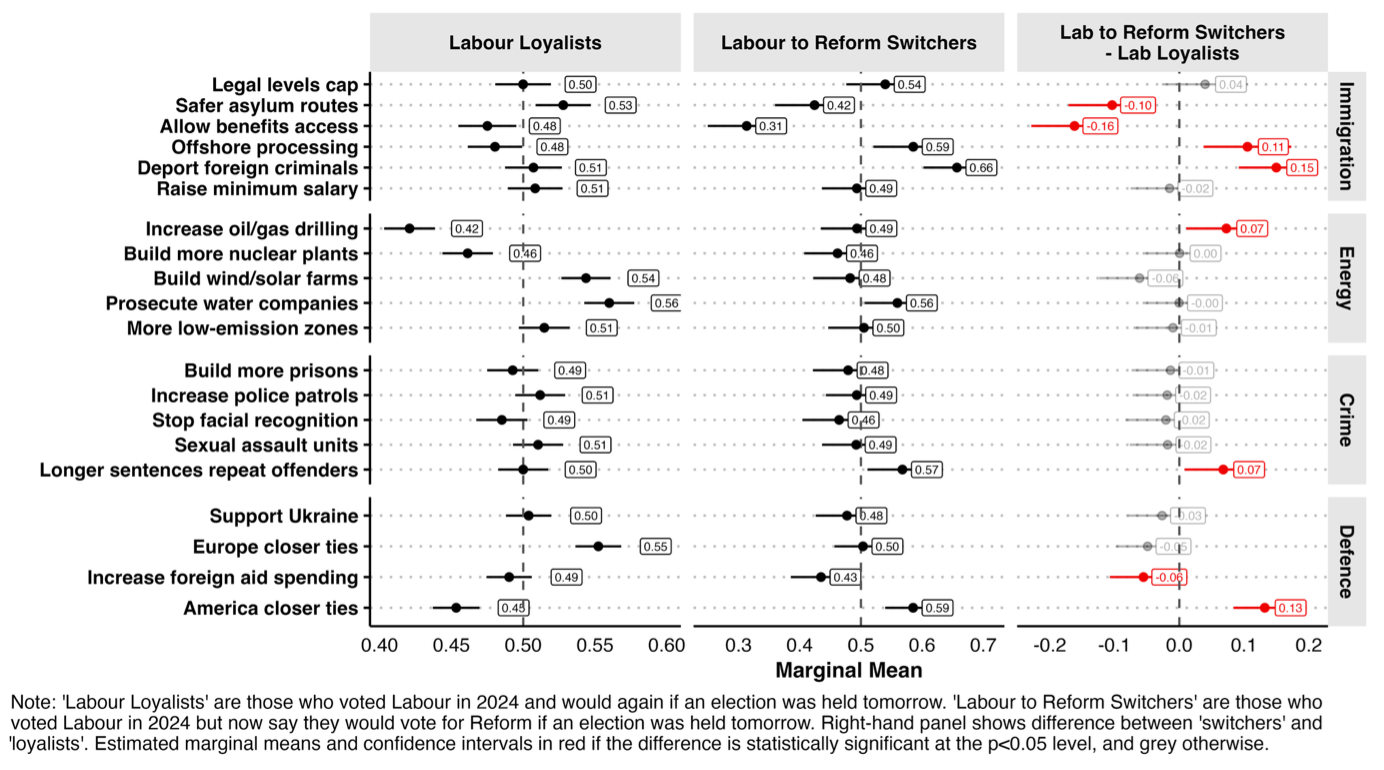
Figure 3. Estimated difference in support between “Labour Loyalists” and “Labour to Reform Switchers”
Although switchers make up a notably small group, their preferences reveal some distinctive patterns. The sharpest differences are on immigration: switchers favour restrictive policies such as offshore asylum processing and deportation of foreign nationals convicted of crimes, while loyalists are more supportive of expanding safer asylum routes. Both groups oppose extending welfare or NHS access to recent migrants, but switchers’ opposition is significantly stronger.
Beyond immigration, contrasts are subtler but consistent. Switchers are more supportive of longer prison sentences, North Sea drilling, and closer ties with the United States. Loyalists prefer renewable expansion, oppose drilling, and lean towards closer ties with Europe. Switchers are also less supportive of foreign aid. Overall, they favour more restrictive and punitive approaches across these issues.
These findings echo wider characterisations of “Reform-curious” Labour voters: socially conservative and concerned with immigration and crime, while retaining left-leaning economic views. The results from this experiment suggest they are not simply disillusioned Labour supporters but hold substantively different preferences. This helps explain why Labour’s attempts to appeal to this group may be unsuccessful, and risk alienating its broader base. Evidence from a recent study of Keir Starmer’s “Island of Strangers” speech in June 2025 reinforces this point: when Labour adopted exclusionary anti-immigration rhetoric, it was perceived as more right-leaning and lost support among its own base, without diminishing the appeal of Reform. A strategy that pivots too sharply to appease Reform-leaning voters may therefore prove unsuccessful while alienating Labour’s broader base.
Voters prefer policies that improve their everyday lives
This analysis shows that, despite the fragmentation of British politics, there are clear patterns of common support in policy preferences. Across the electorate, voters favour visible investment in services: training more NHS staff, expanding renewable energy, prosecuting water companies, or expanding free school meal eligibility. However, divisions also emerge, particularly on identity and deservingness, most prominently around immigration, welfare, and housing.
These divides often reflect differences in lived experience, local conditions, and people’s sense of fairness. Voters appear to respond most strongly to policies that speak directly to their everyday lives – whether by addressing visible problems, protecting services, or signalling who deserves public support.
The challenge for parties is not only to see where the public are united or divided, but to understand why. Examining how voters weigh competing policy platforms reveals which issues cut through the noise of party politics, and which speak most directly to voters’ everyday concerns.
Need help using Wiley? Click here for help using Wiley


