| 10 mins read
SUMMARY
- One of the most commonly-assumed reasons for the increase in voting for anti-immigration parties in western Europe between 2008-2018 is an associated increase in anti-immigration sentiment. This is likely to be false.
- An alternative explanation is that parties have benefitted from a sharp increase in the salience of immigration amongst some voters.
- There are strong correlations over time between the salience of immigration and the polling of anti-immigration parties in most western European countries.
- Aspects of immigration in the last decade have activated pre-existing opposition to immigration amongst a shrinking segment of the populations of western European states.
We were recently intrigued to receive an invitation to present our work on European attitudes to migration at a meeting of senior EU officials. We were informed in the briefing note that a rising tide of anti-immigration sentiment is sweeping across the EU, apparently caused by a hostile media coverage, driving voters into the hands of anti-immigration populists and the radical right.
However, there is little evidence that there is a rising tide of anti-immigration sentiment sweeping across Europe, and the two quite big, assumed causal mechanisms are incorrect. Rather, while there are important forms of variation, attitudes to migration are remarkably stable and have actually become gradually more positive.
Strikingly, positivity actually increased during and since the ‘migration crisis’ of 2015. Attitudes to migration, like attitudes to other political issues, are primarily formed relatively early in life and linked to key formative experiences. The rise of anti-immigration parties is far more likely to be primarily an effect of increased issue salience amongst those with pre-existing dispositions against immigration.
Why does this matter?
Mistaken diagnoses can lead to mistaken remedies. In a May 2018 speech, the EU's Migration Commissioner, Dimitris Avramopoulos linked racism and xenophobia to negative attitudes to migration, implying that opposition to migration is of itself necessarily racist or xenophobic.
Changing peoples’ political attitudes is likely to be very difficult. Allaying their worst fears may be less so. It is possible to be concerned about immigration as it is without being a racist or xenophobe.
What has caused the growth of anti-immigration parties?
One of the most commented upon political trends of the twenty-first century has been the increased electoral support for political parties in western Europe that, while variously labelled as ‘radical’, ‘far’ or ‘populist’ right, share opposition to immigration. In Figure 1, we show the polling results between 2005 and 2018 of the Freedom party of Austria (AT); Flemish Interest (BE); the Danish People's party (DK); the Finns party (FI); the National Front (FR); Alternative for Germany (DE); the Northern League (IT); Alternative Democratic Reform party (LU); the party for Freedom (NL); the Popular party (NO); the National Renovator party (PT); Sweden Democrats (SE); Vox (ES) the Swiss People's party (CH) and the UK Independence party (UK).
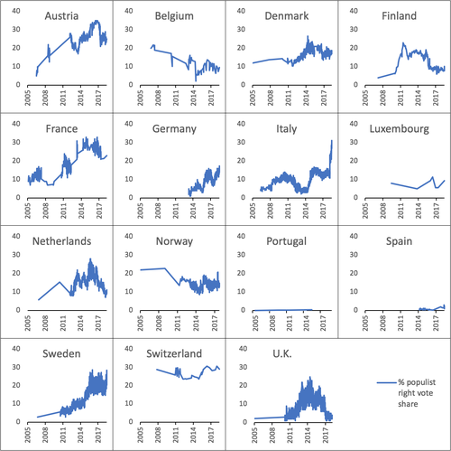
Figure 1: Polling for anti-immigration parties in fifteen western European countries, January 2005 to June 2018
We acknowledge that grouping together the parties is contestable. However, put simply, they are each the primary party in their country that gives high prominence to anti-immigration policies. To varying extents, they also combine Euroscepticism.
Support for these parties has by no means followed a simple, common trend. However, in all fifteen countries except Norway and Belgium, these parties experienced an overall growth in support during the thirteen years. In Portugal and Spain, its overall support remains tiny. In the UK, UKIP experienced impressive growth before steep decline after 2016.
Overall, the largest states of western Europe—Germany, France, the UK and Italy—have all at some point experienced a significant increase in support for anti-immigration parties. This phenomenon has had grave ramifications.
Possible explanations for the increase in anti-immigration parties
What are the major academic explanations for the growth of anti-immigration parties over the last thirty years and specifically the role played by opposition to immigration in these accounts?
First, the ‘economic insecurity’ thesis argues that people vote for anti-immigration parties because of economic grievances against out-groups. Second, according to the ‘cultural backlash’ theory, anti-immigration parties represent a ‘silent counter-revolution’ against the New Left thinkers of the 1970s, for whom traditional institutions, such as the nation state, represent an insult to the universal nature of mankind. This viewpoint was considered by what would become the ‘populist right’ an offence to the social nature of humans.
In terms of national-level specific predictors of anti-immigration party success, Arzheimer identifies four: anti-immigration media; crime; unemployment; and immigration rates. Only evidence for the latter effect is ‘less equivocal’, as found by a long list of studies.
However, an exogenous event cannot lead to a behavioural change without any intermediary change in cognition.
Explaining the rise of anti-immigration parties: attitudinal transformation?
The notion that European electorates are turning against immigration is not evidenced by survey research. Indeed, European Social Survey (ESS) data shows that in fourteen European countries, between 2002 and 2016, attitudes to accepting immigrants ‘from poorer countries outside of Europe’ had become more positive in ten, did not change in two, and had become more negative in a further two. Moreover, between 2014 and 2016, during the biggest spike in support for anti-immigration parties, attitudes became more favourable in nine countries, did not change in four and only became more negative in two. Further evidence is provided by the Eurobarometer.
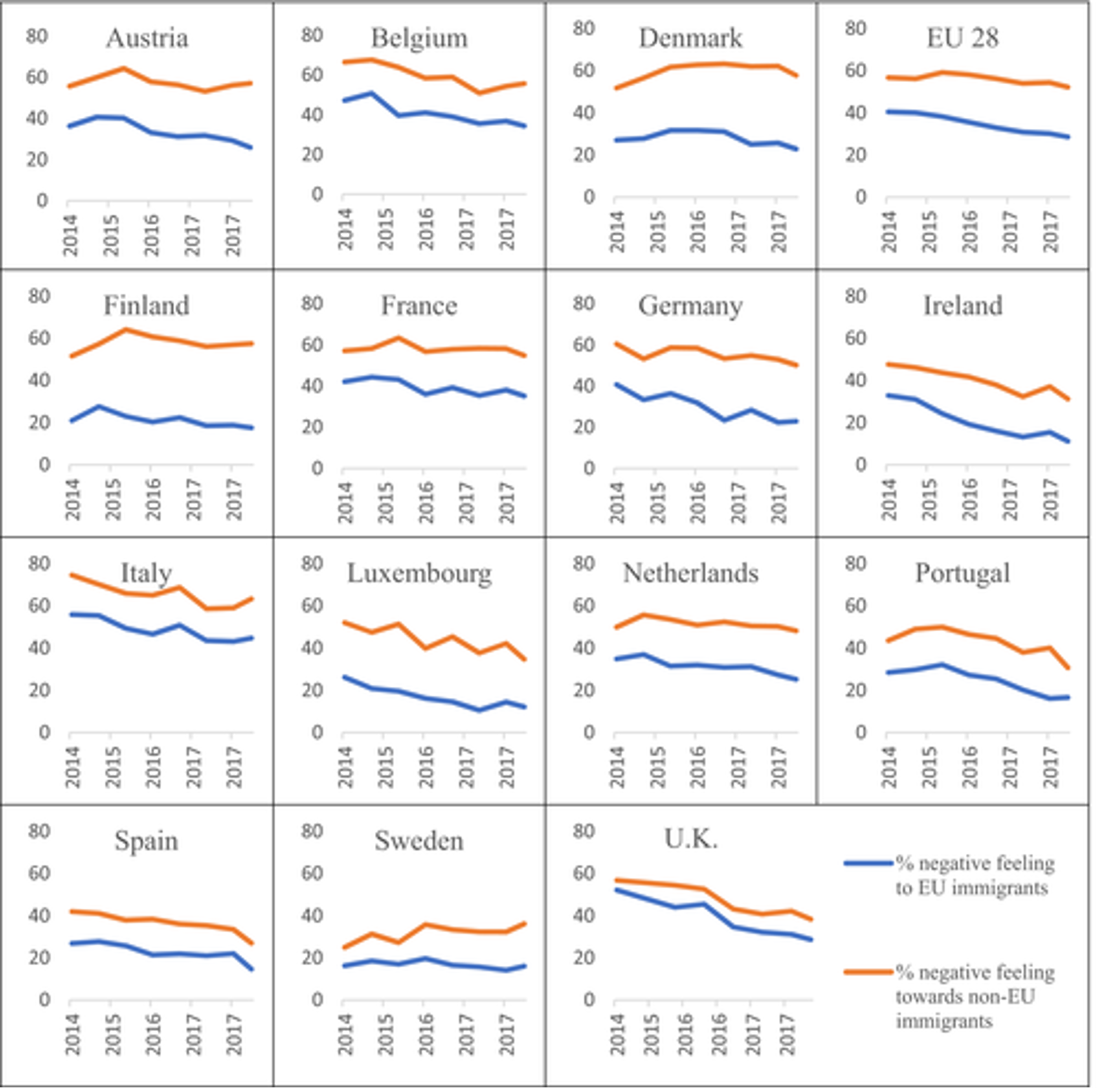
Figure 2: Negative attitudes to EU and non-EU immigrants in the EU-28 and selected western EU member states, 2014–2018
On issue salience
That there has been a rise in support for anti-immigration parties, but there is not a general increase in anti-immigration sentiment represents something of a puzzle. To solve this puzzle, we turn the salience of immigration. Rather than contradict the major existing theoretical explanations, we argue that immigration's salience has the potential to have a large and highly proximal causal effect on voting for anti-immigration parties and to be an important theoretical complimentary component to both the ‘economic insecurity’ and ‘cultural backlash’ theories.
The causes of variance in issue salience remain relatively underexplored.
Perhaps the most consistent finding regarding the causes of cross-time variation is that issue salience responds to actual events and their gravity. This suggests that the extent to which the media can genuinely and durably affect the agenda beyond simply presenting the most ‘objectively’ eventful issues, a concept itself that remains underdeveloped, may be limited.
The salience of immigration and the rise of anti-immigration parties
We now test our idea that the salience of immigration is the most important, though probably not exclusive, issue salience predictor of national-level polling for anti-immigration parties. We do this by using simple correlations of the two variables in eleven western European countries.
For the eleven selected cases, we take measures of issue salience from the pan-EU Eurobarometer survey (Standard Eurobarometer, 89.1).
We take the percentage responding ‘immigration’. The measure of national-level support for the anti-immigration right is taken from the monthly average polling for that party in publicly available polls for general election vote intention in that country (first round of the presidential election in France).
In Table 1, we present correlations between the national level support for the radical right and the salience of immigration on a country-by-country basis, as well as the p-values of the correlations and the number of observations per country.
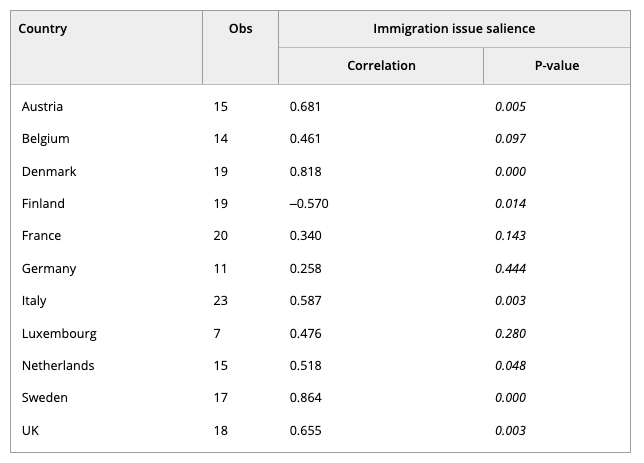
Table 1. Correlations between polling for anti-immigration parties and the salience of the issue of immigration
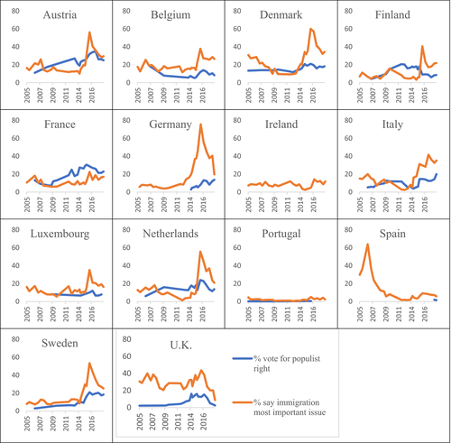
Figure 3 Correlations between percentage listing immigration as one of two most important issue affecting one's country and percentage voting for anti-immigration parties, 2005–2018
Conclusion
Misunderstanding of the causes and effects of attitudes to migration could have corrosive effects that go beyond the politics of migration and spread to wider trust and confidence in political institutions and political leaders. At the meeting, we got the chance to use evidence similar to that presented above to show that the vote share of anti-immigration parties rises and falls not with attitudes to immigration but, to a large extent, with the salience of immigration. In short, behaviour is dictated by priorities as much as by preferences, at least in certain cases.
This finding has important policy implications. We would suggest that it is more likely that the effect of the ‘crisis’ was to activate latent concern about immigration amongst those already predisposed to be concerned about the issue. What it does mean is that communication on migration needs to be couched in ways that appeal or make sense to those with a conservative value orientation (who comprise relatively large sections of European electorates). Allaying the fears of those most alarmed by threats to societal security, conformity or tradition is likely to be both far more achievable and effective anyway, if policy makers wish to stem ongoing electoral polarisation.
Digested read created by Anya Pearson with support from the authors. The full-length article was originally published in The Political Quarterly on 27 November 2018 (Volume 90, Issue 1, January–March 2019).
Need help using Wiley? Click here for help using Wiley